Low Backs, Glutes & Lats by Erik Dalton Ph.D., founder of Freedom From Pain Institute

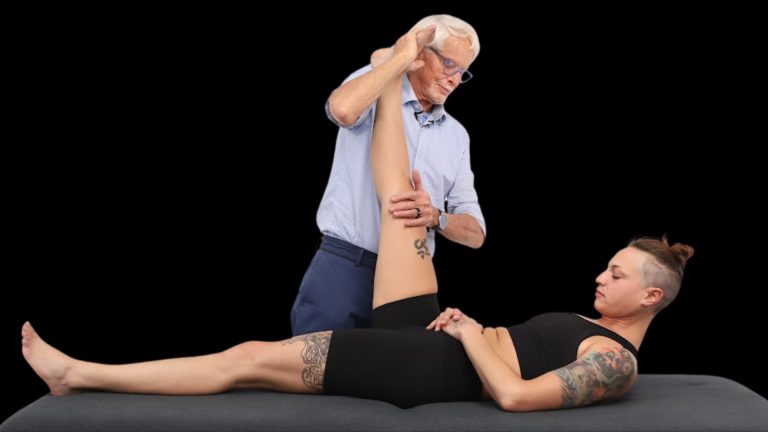
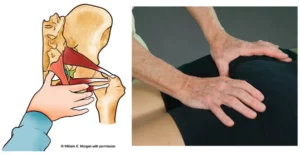
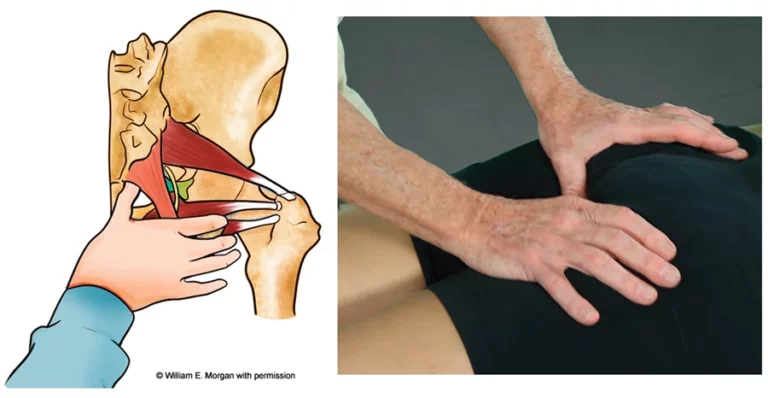
The gluteus maximus was probably the muscle most responsible for pulling us up onto two legs and now look what’s happened to it. Our flexion-addicted lame-ass (no pun intended) society had forced it to be neurologically bullied about by tight hip flexors. If reciprocal inhibition doesn’t completely rob its massive power, injured SI joints and low backs certainly will. It attaches and is continuous with the biceps femoris, long dorsal SI ligaments, thoracolumbar fascia and crosses over to form the posterior spring system with latissimus dorsi (Fig 1).

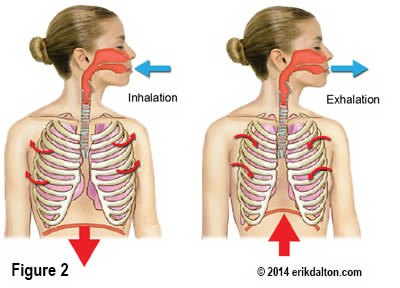
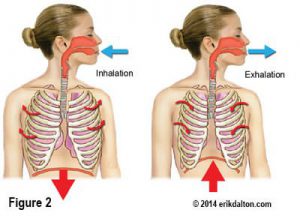
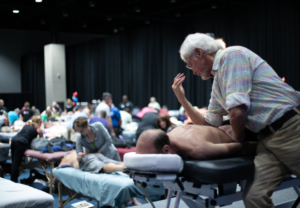
The g-max and lat dorsi are not only dynamic lumbar spine stabilizers, but when working in conjunction with other spring systems, play a major role in coordinated cross-patterned gait (Fig 2).

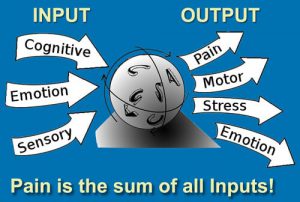
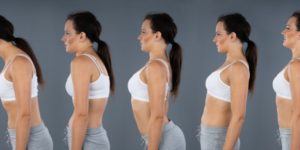
It’s easy to spot those with weak glutes. Due to reciprocal weakness, these folks tend to stand with the pelvis tilted one way or another with their butt kinda “hanging off” the hip capsules and lumbopelvic ligaments. If the muscles, tendons, and fascia are relatively weak in relation to the demands of a particular sport or repetitive activity, the vertebral joints (usually beginning with the disc) will deteriorate (Fig 3). When deterioration becomes severe it can be difficult to carry out the functions of daily living, let alone any high performance athletic endeavor. Any attempt to manually lengthen or stretch weak intrinsic and extrinsic spinal stabilizers causes greater forces to converge on the spinal discs and facets resulting in premature degeneration.

Spindle-Stim Technique

OK, so the glutes are typically weak….whadda we do about em? Even though the clients love it, the last thing we want to do is start massaging and digging around creating more stretch weakness. We could always send them to the gym for squats, leg presses, lunges, or…we could try to tonify them during the therapy session using fast-paced spindle-stimulating techniques.

Try this Spindle-Stim ‘test & treat’ routine:

  • With client prone, ask them to lift their left leg as high as comfortably possible and get a sense of how high the extended leg comes off the table…then test the right.
  • Place the left foot against the right knee forming a “Figure 4″ position with the leg. This places g-max on the stretch.
  • With arms extended, use soft fists and begin bouncing on the left hip..
  • Now, drop your body weight so all the energy is coming from your legs.
  • Working the tissue in all directions, begin to gradually pick up speed until you see the entire body rocking & rolling. (This is not tapotement folks…use your body weight)
  • The goal is to kick in a mild stretch reflex via muscle spindle’s dynamic gamma motoneuron system..
  • After two minutes of rapid spindle-stim stop and retest their degree of hip extension.
  • Results are often dramatic depending on your use of the technique and the degree of weakness the client presents with.
  • Repeat on the opposite side and take notes on the degree of improvement so you can test them next session to see which g-max needs more work.

What about the tight lats?

Gotta love these guys. Considered a lower quadrant muscle, lat dorsi is innervated by the cervical ganglia and instrumental in all shoulder and arm movements, i.e., chopping with an axe. Two major structural/functional problems can occur in the presence of lat hypertonicity:

  • Due to their attachment at the lesser tubercle of humerus, they work with teres major and the clavicular fibers of pec major to internally rotate the humeral head leading to upper cross syndrome patterns, forward head postures and rotator cuff injuries.
  • Optimal functioning of the posterior spring system during cross-patterned gait demands there be precise length/strength balance between g-max and lat dorsi. In the presence of tight lats and weak glutes, the posterior spring system fails to participate with the other spring systems to wind up the lumbar spine and propel the legs forward in the gait cycle.
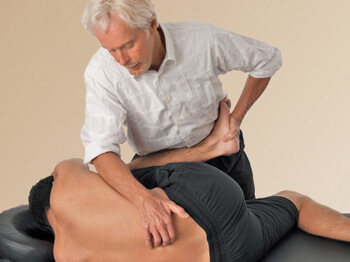
Try this ‘lat-lengthening’ technique:

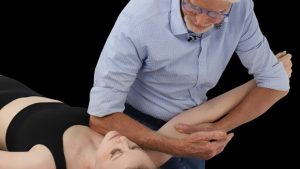
  • The client is left sidelying, knees flexed with his/her right hand grasping the top of the therapy table.
  • With your left hand behind your back, grasp the client’s right ilium and lean against your arm to brace the hip.
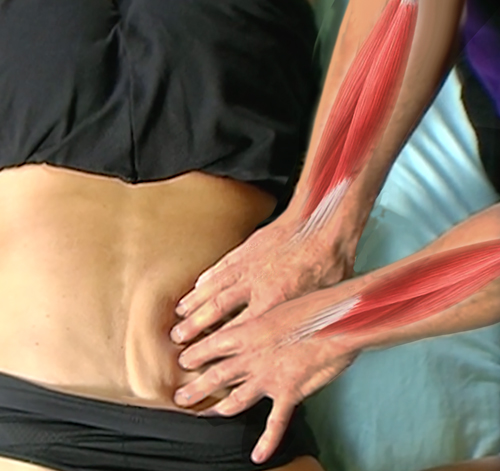
  • Place a soft right forearm along the lateral border of the lat fascia and get a good fascial hook.
  • Establish a counter-force by anchoring with your left hand and slowly hooking and gliding up the lats with your right forearm. The goal is to lift the rib cage off the pelvic girdle and open up the lateral side of the body.
  • After a few strokes, stop and this time ask the client to inhale to a count of 5 while gently pulling up on the top of the therapy table.
  • As they relax and exhale, hook the deeper fascia so you can really decompress lat adhesions and activate the posterior spring system.
  • Repeat on opposite side.

Clips from
Level 4 Dynamic Body
Home Study

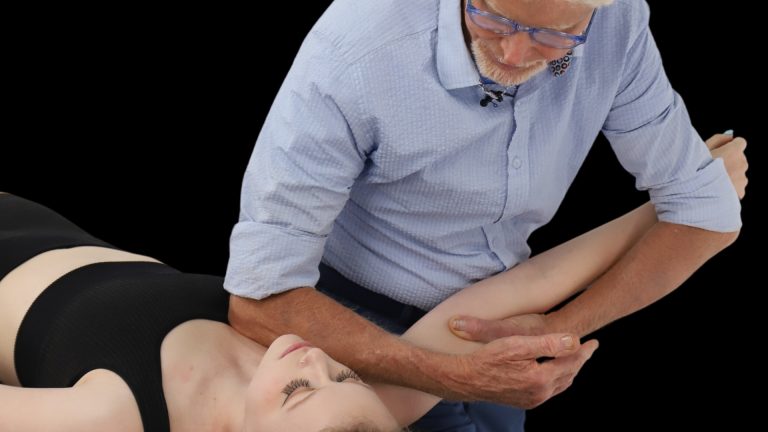
Note: An alternate ‘windshield-wiper’ lat technique is shown in the accompanying video. These are must-use maneuvers for decompressing the lumbar and thoracolumbar segments of this very complex muscle.

GOAL: Help your clients maintain a strong, mobile spine and spinal spring system to minimize injuries and maximize sports performance. Advise against overexertion during competitive or recreational activities to avoid microfailure (fatigue) and eventual spinal degeneration. Remember, the spine cannot support itself without help and that’s where these spinal engine spring system routines come in handy. Restoration of optimal range of motion, length/strength balance and proper firing order are essential components of the Myoskeletal Alignment Techniques(TM).

Tight Muscles or Joint Dysfunction?
by Erik Dalton, Ph.D.

Tight muscles create asymmetry and weak muscles permit asymmetry in both the myofascial and skeletal systems. Deep, intrinsic muscles and the body’s bony framework are inseparable: What affects one always affects the other. Until the therapist develops a basic understanding of how deep tissue techniques affect mobility/stability in the bony framework, random deep tissue work…

Ben Benjamin Interviews Erik Dalton Feb. 29th 9 pm Eastern

The Benjamin Institute announced the third webinar in the Meet the Experts series. Join the live webinar on Wed. Feb. 29th at 9 pm for a live, informal conversation between Erik Dalton, Ph.D. and Ben Benjamin, Ph.D., two of the industry’s most highly regarded teachers. Dr. Benjamin will be interviewing Erik about his background, his…

New Dynamic Body 32CE Home-Study

Level 4 Dynamic Body 32 CE Home-Study

I’m pleased to announce release of the “Dynamic Body” 32-CE home-study course (http://erikdalton.com). Approved by NCBTMB, BOC, New York and Florida State, this 10-piece collection premiers an exclusive free video highlighting the work of contributing book authors. Three years ago we officially launched this adventure with the release of the 6-dvd Myoskeletal Alignment for Low…

SI Joint Stability By Erik Dalton, Ph.D., Freedom from Pain Institute

Iliosacral upslips arise when joint apposition between the ilium and sacrum is altered. That is, the tissues within the joint have upward shear, resulting in deformation, or creep. As a , the sacroiliac grooves ain’t groovin’. Since these superior ilium-on-sacrum shears are more affected by gravity than other iliosacral dysfunctions, they have almost no chance…

Erik Dalton Presenting at the American Massage Conference

April 20, 2012… A full day workshop with Erik and the Dalton Gang! We’ll be discussing “hot-off-the-press” fascial findings from the Vancouver Congress and teaching some cool routines for mobilizing the neck, stabilizing the shoulder girdle and freeing up the ribcage. In the afternoon session, we’ll perform functional assessments from the new Dynamic Body book…

Treating Cycling Injuries

Like many of America’s other popular, but functionally abnormal, athletic endeavors, such as golf, tennis, and bowling, cyclists bring with them a complex biomechanical downside that’s often hard to completely fix. If you are a massage therapist or athletic trainer who treats cyclists it’s vital to precisely identify the anatomical structure at fault, and weed…

Stilettos… A Pain In The???

by Erik Dalton, Ph.D. The biomechanical effect of heels in everything from running shoes to stilettos has puzzled researchers and fired controversy for almost a century. In a highly functioning body, the neuro-myo-skeletal system ‘hangs’ in dynamic equilibrium, each part balancing the other. But when a woman wears high heels, a new dynamic equilibrium occurs…

Is Pain-Management Recession Proof?

Look at the $$$ we’re spending. New report from the Institute of Medicine: “Healthcare providers should tailor pain care to each patient’s experience and promote self-management of chronic pain, a condition that affects more than 116 million Americans and costs the U.S. up to $635 billion annually in medical treatment and lost productivity.”

Chicago Countdown!

Due to popular demand, the Myoskeletal Workshop has been moved to a bigger convention center across from the hotel. Great TAs, new material, lots of fun (always). Don’t miss this one August 5-7 http://tinyurl.com/DaltonChicago